
In short. The barrier keeps water in and irritants out. How it breaks down, what the warning signs are, and the routine that rebuilds it without relapsing.
Key points
- Stop the actives: retinoids, acids, scrubs, foaming cleansers and heavily fragranced products.
- Wash with lukewarm water and a mild non-foaming cleanser, once or twice a day.
- Apply a simple moisturiser containing humectants, emollients and an occlusive to damp skin, repeatedly through the day.
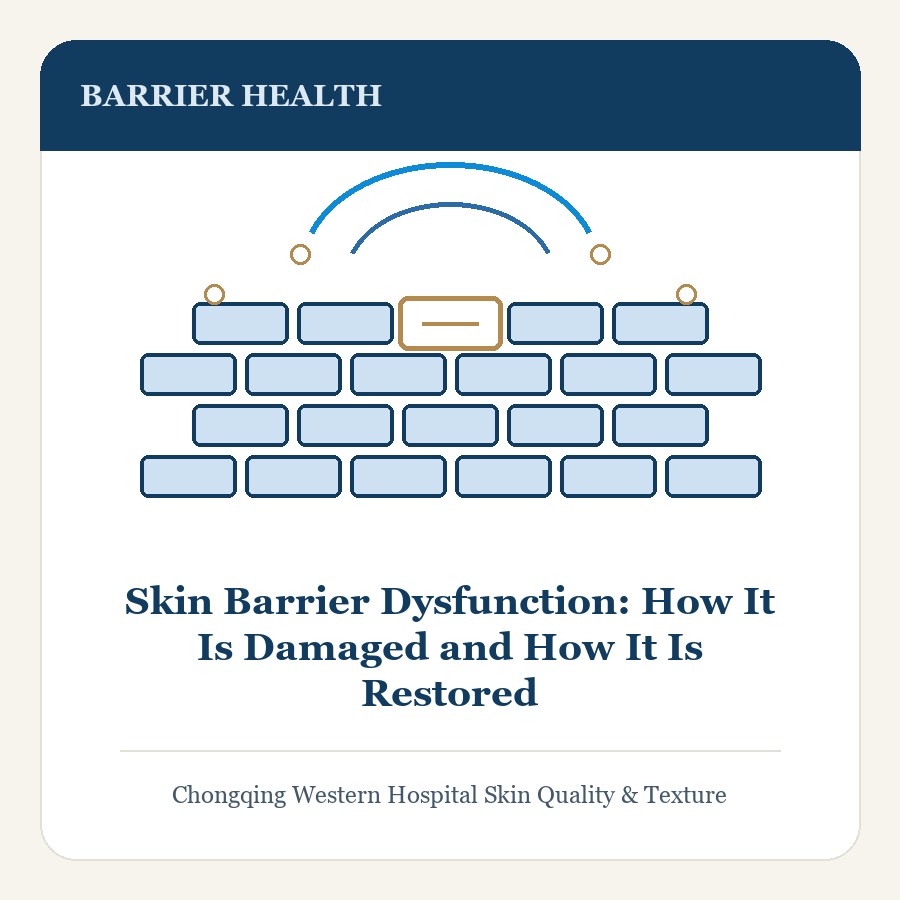
The skin barrier is the outermost part of the epidermis: flattened cells packed in an organised lipid matrix, with a slightly acidic surface and a community of resident organisms. It does two jobs at once. It keeps water in, and it keeps irritants, allergens and microbes out. When it fails, both jobs fail together.
How the barrier is damaged
The most common cause is what people apply. Foaming cleansers, alcohol-based toners, physical scrubs, repeated acid exfoliation and layered active ingredients all strip lipids and disrupt the cells. Using several active products at once is the single most frequent history we take. Hot water and long showers do the same thing. So does over-treatment in clinic: too frequent peels, too high an energy setting, or treatments spaced too closely together.
Beyond products, barrier function is reduced by cold dry air, ultraviolet exposure, some medicines, and by conditions such as eczema, psoriasis and rosacea. Psychological stress measurably slows barrier recovery.
What barrier damage looks like
Stinging or burning when applying products that never used to sting. Tightness after washing. Rough and flaky patches. Redness that comes and goes. Increased sensitivity to sun and to temperature change. Dryness that moisturiser no longer fixes. Itching, and small cracks at the corners of the mouth or nose. These are the signs, and they are usually interpreted as a reason to buy more products rather than to stop using them.
How the barrier is restored
Stop the actives: retinoids, acids, scrubs, foaming cleansers and heavily fragranced products. Wash with lukewarm water and a mild non-foaming cleanser, once or twice a day. Apply a simple moisturiser containing humectants, emollients and an occlusive to damp skin, repeatedly through the day. Protect from wind and sun with a physical sunscreen. Expect two to four weeks before the skin feels normal, and reintroduce one active at a time afterwards.
Rebuilding without relapsing
Once the barrier has recovered, active ingredients can be restarted — one at a time, at low frequency, with a moisturiser underneath. The rule is that the routine should be boring and consistent rather than impressive. Skin that is treated gently tolerates treatment better.
Barrier damage is the most common reason skin looks worse after a period of intensive treatment. Doing less, for longer, is usually the treatment.
See a doctor if
- Skin is weeping, crusting, blistering or increasingly painful, which may indicate infection or a severe reaction.
- Redness spreads rapidly, or you feel unwell with it.
- Barrier symptoms persist despite several weeks of genuinely gentle care, which suggests eczema, rosacea or another diagnosis.
Frequently asked questions
What is the most common cause of barrier damage?
What people apply. Foaming cleansers, alcohol-based toners, physical scrubs, repeated acid exfoliation and layered active ingredients all strip lipids and disrupt the cells. Using several active products at once is the single most frequent history taken in clinic, and over-treatment in clinic does the same.
How long does the barrier take to recover?
Two to four weeks is typical before the skin feels normal. Recovery means stopping the actives, washing with lukewarm water and a mild non-foaming cleanser, moisturising to damp skin repeatedly, and protecting from wind and sun. Actives are then reintroduced one at a time.
Is redness a reason to add more products?
No, and that instinct works against recovery. The signs of barrier damage are usually interpreted as a reason to buy more products rather than to stop using them. Barrier damage is the most common reason skin looks worse after a period of intensive treatment.
Risks & Limitations
- Skin quality changes gradually. Improvement is measured in months, not days, and maintenance is continuous.
- No product, device or procedure reverses ageing; treatments improve particular features, partially and for a limited time.
- Over-treatment — too many active ingredients, peels or energy sessions too close together — damages the barrier and makes skin look worse.
- Energy devices and deeper peels can cause burns, blistering, prolonged redness and post-inflammatory pigmentation, with a higher risk in darker skin tones.
- Skin boosters and other injectables carry risks of bruising, swelling, irregularity and, rarely, vascular complications.
- Results vary with skin type, age, sun exposure, adherence to the routine, and individual healing response, and cannot be predicted with certainty.
- Sun protection is essential to any plan; without it, pigment and texture improvements are lost.
When to Seek Care
- Blistering, broken skin, weeping or crusting after any product or procedure — stop and seek medical review.
- Spreading redness, swelling, pain or pus, or fever with a skin change.
- A new or changing pigmented lesion, or a spot that bleeds, itches, crusts or fails to heal.
- Severe reaction to a topical product, or swelling of the face, lips or throat — seek emergency care.
- Dryness, redness or flushing that persists despite weeks of genuinely gentle care, which may indicate eczema, rosacea or a systemic cause.
References & Further Reading
- American Academy of Dermatology (AAD) — public and clinical guidance on skin care and photoprotection
- American Society for Laser Medicine and Surgery (ASLMS) — guidance on energy-based treatment and safety
- Chinese Medical Association, Dermatology Branch — clinical guidance
- Cochrane Library — systematic reviews in dermatology and skin care
- World Health Organization (WHO) — ultraviolet radiation and skin health resources
This page is patient education, not medical advice, and it does not cite individual studies. Discuss your own case with a qualified clinician. To arrange an assessment at Chongqing West District Hospital, see Contact & Consultation.