
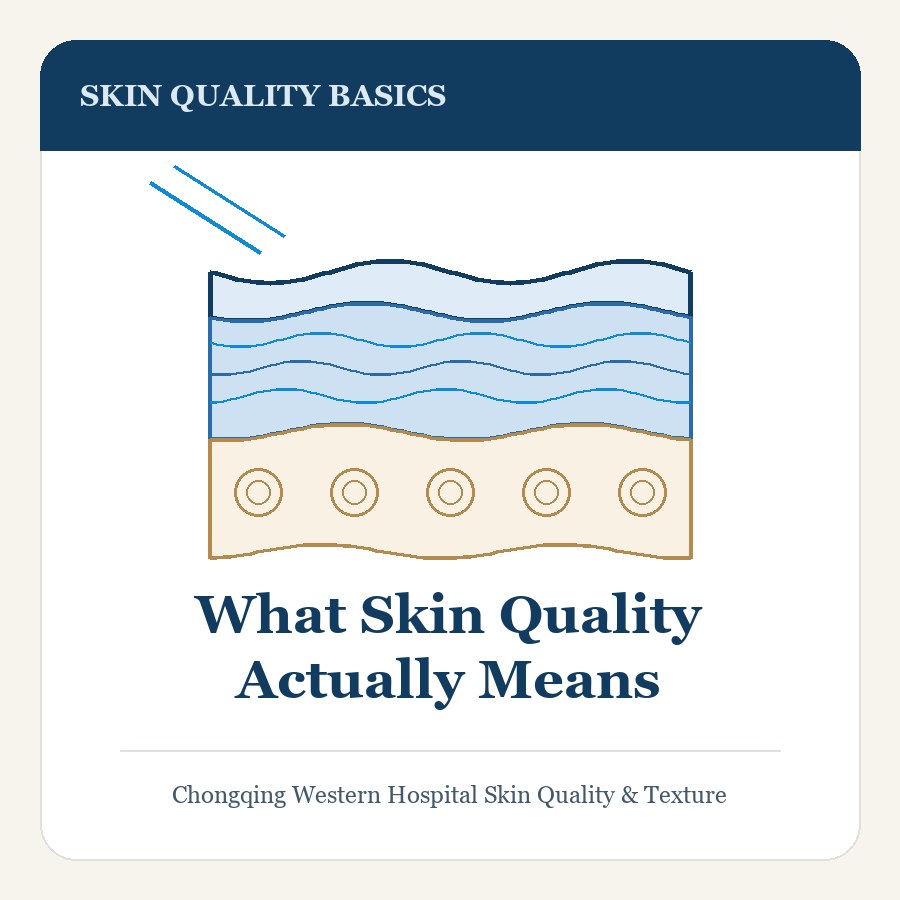
In short. Skin quality is not one thing. Texture, tone, firmness and hydration are four separate properties, and each responds to different things.
Key points
- Skin quality varies with age, genes, hormones, sleep, medication, sun exposure and how much time is spent in dry indoor air.
- Some of that is within your control and some is not.
- What is genuinely within reach is slow improvement in texture, tone and hydration, and protection against further change.
Skin quality is the everyday phrase for how skin looks and behaves when nothing is acutely wrong with it. It is not a diagnosis and not a single measurement. Four properties, taken together, account for most of what a person sees in the mirror.
Texture is how smooth the surface is: pore size, fine lines, and the small irregularities left by sun exposure or old inflammation. Tone is evenness of colour — whether redness, brown marks or sallowness break up an otherwise uniform surface. Firmness is the mechanical quality of the skin: its thickness, its elasticity, and how well the underlying support holds the face. Hydration is water content and the state of the barrier that keeps water in.
Why the four should be separated
Each of the four has a different cause and responds to different things. Hydration can improve within days. Texture and tone improve over months. Firmness changes slowly and often incompletely, because it depends on collagen and on structures below the skin. A plan that promises to improve all four at once, at the same speed, is not describing how skin works.
The separation also protects against over-treatment. Redness and stinging are usually barrier problems, and the correct response is to do less rather than more. Pigmentation is a tone problem, and scrubbing it will not lighten it. Loose skin is not a texture problem, and no cleanser will tighten it.
The honest framing
Skin quality varies with age, genes, hormones, sleep, medication, sun exposure and how much time is spent in dry indoor air. Some of that is within your control and some is not. What is genuinely within reach is slow improvement in texture, tone and hydration, and protection against further change.
What actually moves the needle
Photoprotection is the single most effective intervention, because most visible ageing of skin is cumulative ultraviolet exposure. Not smoking, sleeping adequately, and treating dry skin and barrier damage properly all help. A short and consistent topical routine does more than a long and aggressive one. In-clinic treatment can add to this, but it adds to it — it does not replace it.
Nothing available reverses ageing. Products and devices improve particular features, to a variable degree, for a limited time, and only while they are maintained.
See a dermatologist if
- Redness, stinging, itching or flaking persists, which suggests a barrier or inflammatory condition rather than a cosmetic concern.
- A mole or patch changes in size, shape or colour, or starts to bleed or crust.
- Skin changes come with fatigue, weight change or hair loss, which may point to a systemic cause.
Frequently asked questions
Which of the four properties of skin quality can improve fastest?
Hydration is the fastest to change and can improve within days. Texture and tone respond over months, while firmness changes slowly and often incompletely, because it depends on collagen and on structures below the skin. No plan should promise all four at the same speed.
If skin is red and stinging, is scrubbing the answer?
No. Redness and stinging are usually barrier problems, and the correct response is to do less rather than more. Pigmentation is a tone problem and scrubbing will not lighten it. Loose skin is not a texture problem either, and no cleanser will tighten it.
What single measure does most for skin quality?
Photoprotection, because most visible ageing of skin is cumulative ultraviolet exposure. Not smoking, sleeping adequately, and treating dry skin and barrier damage all help. A short consistent topical routine does more than a long aggressive one, and in-clinic treatment adds to a routine rather than replacing it.
Risks & Limitations
- Skin quality changes gradually. Improvement is measured in months, not days, and maintenance is continuous.
- No product, device or procedure reverses ageing; treatments improve particular features, partially and for a limited time.
- Over-treatment — too many active ingredients, peels or energy sessions too close together — damages the barrier and makes skin look worse.
- Energy devices and deeper peels can cause burns, blistering, prolonged redness and post-inflammatory pigmentation, with a higher risk in darker skin tones.
- Skin boosters and other injectables carry risks of bruising, swelling, irregularity and, rarely, vascular complications.
- Results vary with skin type, age, sun exposure, adherence to the routine, and individual healing response, and cannot be predicted with certainty.
- Sun protection is essential to any plan; without it, pigment and texture improvements are lost.
When to Seek Care
- Blistering, broken skin, weeping or crusting after any product or procedure — stop and seek medical review.
- Spreading redness, swelling, pain or pus, or fever with a skin change.
- A new or changing pigmented lesion, or a spot that bleeds, itches, crusts or fails to heal.
- Severe reaction to a topical product, or swelling of the face, lips or throat — seek emergency care.
- Dryness, redness or flushing that persists despite weeks of genuinely gentle care, which may indicate eczema, rosacea or a systemic cause.
References & Further Reading
- American Academy of Dermatology (AAD) — public and clinical guidance on skin care and photoprotection
- American Society for Laser Medicine and Surgery (ASLMS) — guidance on energy-based treatment and safety
- Chinese Medical Association, Dermatology Branch — clinical guidance
- Cochrane Library — systematic reviews in dermatology and skin care
- World Health Organization (WHO) — ultraviolet radiation and skin health resources
This page is patient education, not medical advice, and it does not cite individual studies. Discuss your own case with a qualified clinician. To arrange an assessment at Chongqing West District Hospital, see Contact & Consultation.