
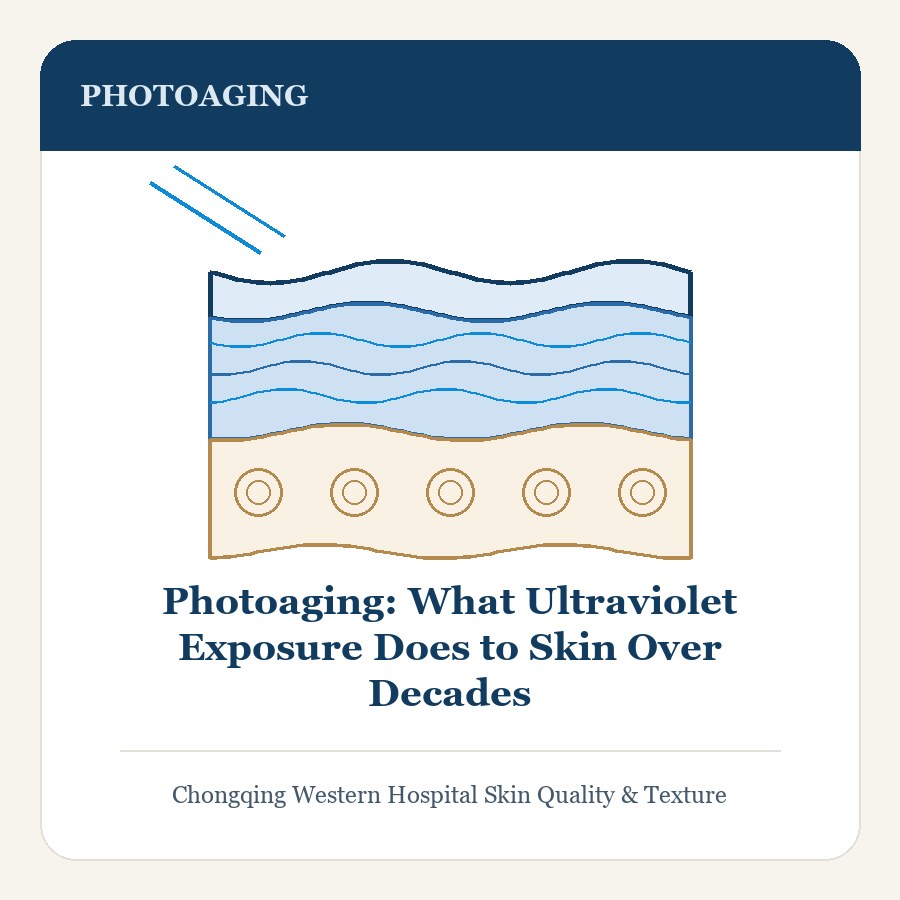
In short. Most visible skin ageing is cumulative sun exposure rather than the passage of time. What ultraviolet light does to collagen, pigment and the surface.
Key points
- Photoprotection stops further accumulation and is the only intervention with a genuine preventive effect.
- Topical retinoids can improve surface texture and some pigment over months.
- Energy-based treatments and chemical peels improve pigment and texture and, modestly, laxity.
Skin ageing has two components. Intrinsic ageing is what happens with time and is largely genetic: skin thins, loses elasticity and develops fine lines. Photoaging is what happens with ultraviolet exposure, and in most people it accounts for the majority of what is visible. It is also the component that is preventable.
What ultraviolet light does
Ultraviolet B damages DNA directly in the cells it reaches, which is why it burns. Ultraviolet A penetrates deeper, generates reactive molecules and damages collagen and elastin in the dermis without necessarily burning at all. Over years, the dermis loses organised collagen, elastin becomes clumped and dysfunctional, and the skin becomes lax, leathery and coarse.
The pigment system changes too. Melanocytes become unevenly distributed and irregularly active, producing mottled pigmentation, sun spots and a sallow overall tone. Blood vessels become permanently dilated, so the face carries a diffuse redness. The surface becomes rough, pores look larger, and precancerous lesions appear.
Why the pattern matters
Photoaging is not uniform. It is worst on the areas with the highest cumulative exposure: the face, the neck, the backs of the hands and the forearms. The neck and the hands often reveal age more accurately than the face, because they are treated less and protected less. The pattern also matters clinically: marked photoaging is a risk marker for skin cancer, and it is a reason for a proper skin examination rather than a cosmetic consultation.
What can and cannot be undone
Photoprotection stops further accumulation and is the only intervention with a genuine preventive effect. Topical retinoids can improve surface texture and some pigment over months. Energy-based treatments and chemical peels improve pigment and texture and, modestly, laxity. None of them restores skin to what it was, and all of them require maintenance.
Prevention is the whole argument
Sunscreen used daily and reapplied, combined with shade, clothing and avoiding peak-hour exposure, reduces further damage. It does not reverse what is already there, but it protects the results of any treatment and slows the change that would otherwise continue. Tanning, whether from the sun or from a sunbed, adds exposure with no benefit at all.
See a dermatologist if
- A spot is new or changing, or itches, bleeds or crusts, or a sore that does not heal.
- A mole differs from the others, has irregular borders or more than one colour, or is larger than a pencil eraser.
- You have had significant sun exposure, sunbed use or a previous skin cancer — periodic skin examination is then a medical need.
Frequently asked questions
Which ultraviolet band damages collagen without burning?
Ultraviolet A penetrates deeper, generates reactive molecules and damages collagen and elastin in the dermis without necessarily burning at all. Ultraviolet B damages DNA directly in the cells it reaches, which is why it burns. Over years elastin becomes clumped and skin becomes lax.
Why do the neck and hands reveal age more than the face?
They carry high cumulative exposure and are treated less and protected less. Photoaging is worst on the face, the neck, the backs of the hands and the forearms, so the pattern of change itself is a clinical clue rather than only a cosmetic one.
Does sunscreen reverse photoaging that has already happened?
No. It does not reverse what is already there, but it stops further accumulation, protects the results of any treatment, and slows the change that would otherwise continue. It is the only intervention with a genuine preventive effect, and tanning adds exposure with no benefit at all.
Risks & Limitations
- Skin quality changes gradually. Improvement is measured in months, not days, and maintenance is continuous.
- No product, device or procedure reverses ageing; treatments improve particular features, partially and for a limited time.
- Over-treatment — too many active ingredients, peels or energy sessions too close together — damages the barrier and makes skin look worse.
- Energy devices and deeper peels can cause burns, blistering, prolonged redness and post-inflammatory pigmentation, with a higher risk in darker skin tones.
- Skin boosters and other injectables carry risks of bruising, swelling, irregularity and, rarely, vascular complications.
- Results vary with skin type, age, sun exposure, adherence to the routine, and individual healing response, and cannot be predicted with certainty.
- Sun protection is essential to any plan; without it, pigment and texture improvements are lost.
When to Seek Care
- Blistering, broken skin, weeping or crusting after any product or procedure — stop and seek medical review.
- Spreading redness, swelling, pain or pus, or fever with a skin change.
- A new or changing pigmented lesion, or a spot that bleeds, itches, crusts or fails to heal.
- Severe reaction to a topical product, or swelling of the face, lips or throat — seek emergency care.
- Dryness, redness or flushing that persists despite weeks of genuinely gentle care, which may indicate eczema, rosacea or a systemic cause.
References & Further Reading
- American Academy of Dermatology (AAD) — public and clinical guidance on skin care and photoprotection
- American Society for Laser Medicine and Surgery (ASLMS) — guidance on energy-based treatment and safety
- Chinese Medical Association, Dermatology Branch — clinical guidance
- Cochrane Library — systematic reviews in dermatology and skin care
- World Health Organization (WHO) — ultraviolet radiation and skin health resources
This page is patient education, not medical advice, and it does not cite individual studies. Discuss your own case with a qualified clinician. To arrange an assessment at Chongqing West District Hospital, see Contact & Consultation.